Wednesday, May 26, 2010

Ghost Town Tuesday - Emmaville rules them all!

Alright, today’s ghost town is a particularly interesting little place. Well, kind of. It WAS an interesting little place. Nowadays it’s not as interesting. Either way it’s too late to stop reading this. Even if you close this blog right now and vow to never return (which is what most people do), you will be plagued by curiosity as to what ghost town I could have possibly been talking about. And don’t think I’m going to help you out by just telling you right here at the start. No, you have to endure the whole post to get to the good stuff. It’s like how all those celebrity gossip shows promise pictures of bikini-clad ladies if you stay tuned through the story about how one of the little rascals just died.

Sadly, this post features no bikini-clad ladies. If that’s what you’re after, then perhaps you haven’t explored the internet enough. This post is about this ghost town…..


That’s a picture of granite block. It will make sense later on. Maybe. I don’t know if anything I write makes sense. Anyway, the town’s name was Emmaville.

Emmaville was a bustling little community established in 1868 at the base of Little Cottonwood Canyon. In modern times, that would place it pretty close to Wasatch Boulevard, but back in the day this portion of the Salt Lake Valley was just as wild as any other part of the Old West. Gone were the traffic lights of today and in their place stood trees. Giant trees that may or may not have looked like traffic lights. Anyway, what the trees looked like is not important. What is important is that we realize that comforts of Salt Lake City had not reached anywhere near this portion of the valley back then. The canyons were still in the same place as they are today though. Canyons don’t move much. Here is a picture of Little Cottonwood Canyon as it appears from the Emmaville townsite.


As is the case with most ghost towns in Utah, the city of Emmaville is another colorful thread in the tattered saddle blanket that is mining. Now, if you are familiar with the Salt Lake Valley, you will realize that mining anywhere in the Valley is probably not a clever idea. The valley is filled with mud and goo left over from Lake Bonneville, and should you choose to dig a mine in the valley you should know that very few useful things come out of goo-mines. No, if you want valuable rock-based goods then you need to head to the mountains. Which is exactly what people did. The story of Emmaville begins largely with yet another ghost town named Alta, a booming little mining place located up Little Cottonwood Canyon and which in 1868 was filled with all sorts of prospectors and mules and whatever else people had back then.


A problem arose when the miners had filled up their mules with ore and headed out for Salt Lake City to go cash it in and buy some whiskey and some more of those crazy prospector hats that have the brim in front that sticks straight up. These ones…

You see, Alta is pretty far away from anything useful. This is especially problematic when you consider that the average prospector rarely had a nutritional input that didn’t end in “iskey” or “rostitutes”. In a good day you could drag your ore-laden mule from Alta to the bottom of Little Cottonwood Canyon, but you would still find yourself a good 20 miles from Salt Lake City. I’m not sure it’s 20 miles actually. It’s pretty far. It takes around 25 to 30 minutes to drive there nowadays, so I’m guessing that 20 miles is a pretty good bet. Don’t hold me to that though.

This same problem also existed for the folks working the granite quarry at the mouth of Little Cottonwood Canyon. If you ever wanted to work in a granite quarry, you should have been alive in 1870. Massive blocks of the stuff were being pulled out of the hillside in order to construct the Salt Lake temple, and it turns out that there just isn’t enough time in a day to run up the canyon, chisel out a huge block of granite, stick it on some sort of cart and get back to town.
So there you were, sitting at the bottom of the canyon with several big bags of rocks and no place to rest your sleepy prospector head. Thus, the community of Emmaville was created to serve as a place to stay, park your mule or granite block, and put your feet up. It was sort of a KOA campground, but with more swearing and mules. Or maybe less swearing and mules if you are staying at a particularly unfortunate KOA. Either way, it grew up fast, and soon the little community had three saloons, a blacksmith shop, a stable, a slaughter house and a healthy population of around 500 people. Things were really looking up for the happy little community of Emmaville. Luckily, good times tend to last forever…..right?

In 1871 everyone caught small pox and died. Also everything burned down. The fates had dealt a cruel hand to the jittery gambler that was the town of Emmaville. If it wasn’t enough that everyone was dead and the stuff was burnt to the ground, the cold grasp of industrialization had just arrived on the scene. The railroad built a line that made it possible to get your ore-mule and granite blocks from Little Cottonwood Canyon to Salt Lake in a day, thus cutting in on the profits of our little saloon-laden KOA.

And so, Emmaville died and burnt to the ground. But don’t you worry! We humans are resilient little buggers. 75 years later we were back at the same spot building another town. One with better medical care and working fire hydrants. Nowdays the same area is known as Cottonwood Heights. Or it may possibly be part of Sandy. I don’t know and it doesn’t really matter unless you are really into city boundaries. And if you are then perhaps you need to reassess your life.

Finding Emmaville is a bit of challenge, what with it having all burned down and such. There is a marker that has been placed along Wasatch Boulevard that commemorates the townsite. I drove that road back and forth and all I could see was this thing…


That’s the same picture from before, but now it makes sense. Anyway, I thought this was the marker, but I was wrong. It turns out that the marker is somewhere else, but there were a lot of dogs walking around the day I was out there and there is no way I am dedicated enough to this to risk rabies. So this will have to do as a marker. The next step in getting to the townsite is to drive 0.1 miles south and find a street named Danish Road, or Lane, or something like that. Look! I found it!


We are close! Now to drive .4 miles down Danish, past the water treatment plant….


And bam! There you are! Right in the middle of Emmaville! Look! Here we are!


It’s now a street! Admittedly this is a disappointing turn of events. There really is nothing left that would suggest that there was once a town there. It’s not even that great of a street. The curb-work was horrible, and there were more than a few potholes. Maybe the potholes were created as pioneer zombies rose from their graves? Nope. It’s far more likely that the asphalt has simply worn away over time. I guess people do dig up skeletons from time to time which confirms that this was indeed the site of Emmaville. This is pretty neat, but not neat enough to warrant me driving all the way out there. The worst part is that I had this huge granite block in the back of my car and I was totally looking to rest for a while. Nah, that’s a lie. I can’t fool you guys.

So, there really isn’t much to report. Do you want to see more pictures of the street? Here you go.


There was a ditch off to one side of the street if that excites you at all. It was filled with various bits of trash. Nothing pioneery though. Just modern stuff. See?


There was one high point though. Look! A bunch of quail!


Perhaps the good people of Emmaville once looked upon these very same quail as they loaded up their granite or just got loaded. Makes you think. Oh, the town got its name from the Emma Mine, a mine located at the center of a nasty little incident that was summarized in the Gold Hill post. The Emma mine is located up near Alta and was a pretty big deal back in 1870, so I’m guessing people just thought, hey, what the hell. Let’s call this place Emmaville.

So that’s it. A lot of driving for some pictures of a street. I hope you are all happy.

Saturday, May 22, 2010

Green to Brown rocks

You know what? You deserve a break. You work hard all day for a few measily dollars while those wall-street fat cats roll in ill-gotten riches. So today, I'm going to give you something very special. A wise man once said that chicken will feed a man for several meals, but knowledge will give a man the powers to think like a chicken and thereby granting him access the chicken's secrets. In that vein, I have decided to present to you a very special bit of knowledge. Today, we will be looking at a very important mineral. Come, let me once again take you by the brain and drag you through the lands of earthly pleasures!

As I mentioned in that gripping introduction, today's mineral is a very special mineral indeed. We are going to be investigating the magical world of the green to brown rock. Namely, this green to brown rock...


Here is the green to brown rock next to three plastic dinosaurs and a Pistol Pete bobblehead doll.


Here is a picture of just the dinosaurs.


And here is a picture of a black Santa soap dispenser.


So, as is important to do with any sort of investigation, be it of geologic nature or not, we need to create a list of what we know about green to brown rocks. Let's do that now.

1) The are green to brown
2) They are easily confused with undercooked/overcooked potato chips

That's a good list, but let's not get ahead of ourselves. We aren't green to brown rock specialists yet! No, like all other things in geology, we need to run some random, creative tests upon the green to brown rock in order to determine some other stuff about it. Let's do that now!

The first thing I like to do when investigating a rock that does NOT contain the primary colors is to see if it will levitate.....


No, green to brown rocks do not seem to levitate. You might find the result of this experiment sad, but remember, there are no disappointments in science! Except for those poor saps who discovered radiation. Alas poor Marie Curie! We knew thee not! *glowing sound*

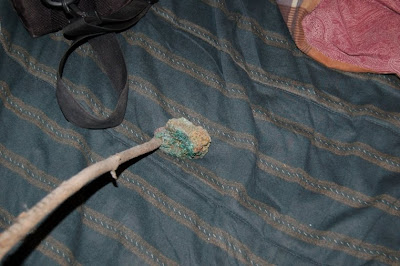
Next I like to run a test where I poke the green to brown rock with a stick. Let's see what happens....


The green to brown rock does not seem to react to simply bullying. This is a good fact to note in your notebooks, which I'm assuming you have all been keeping updated as we have been moving forward with our investigation!

A good investigation technique in geology is to see if one mineral will react with various chemicals. Pyrite reacts with water, Barite reacts with calcium, and sometimes I react with very fizzy colas. Let's see what happens to our green to brown rock if we cover it with sugar we found in the kitchen....


Nothing. My, our green to brown rock is really turning out to be quite geological bore! But we won't stop there. Sometimes to get a reaction from something we have to prey upon it's most basic instincts. So let's see if the green to brown rock will react to some saucy playing cards....


No, it does not seem that our rock has any interest in the gam-rich playing cards. At this point it is important to note that we cannot and should not judge the author of this article for owning the materials for completing this experiment. There were a souvenir from the USS Midway, and my owning them is simply a symbol of my patrotism.

Perhaps the green to brown rock requires something a little more...high-brow...to invoke a reaction. Let's place it in front of a felt picture of a conquistador.


Still nothing. But again the lack of a reaction is a reaction in itself! We are really learning quite a bit about the green to brown rock.

It is important to note that teenagers today love creepy stickers. Therefore, a logical test to run next is to see if a creepy sticker will scratch a green to brown rock. Let's see what we can do.....


Well, it turns out that our green to brown rock is definitly harder than a creepy sticker.
So now we can add to the list we created at the start!

1) The are green to brown
2) They are easily confused with undercooked/overcooked potato chips
3) They tend to obey gravity
4) They are indifferent to being poked by a stick
5) They do not interact with sweeteners
6) They do not respond with saucey playing cards
7) Scott is a true American for owning those saucey playing cards
8) They care very little for felt-based pictures of historical figures
9) They seem to be harder than creepy stickers

We are up to 9 items that we know about green to brown rocks! Nine items! Now we're getting somewhere!

So, now that we know all about green to brown rocks, let's talk about where to find them. People can get intimidated by the task of finding a green to brown rock fearing that they will meet with poor results. Well, lucky for you I'm going to show you "zones" where you can search and enjoy a significantly higher success rate in searching for green to brown rocks.


This map is simple to understand and will increase your rate of success by nearly 35%. And not just in finding green to brown rocks, but in love, money, power and rocks of various other colors. But let's save those for next time!
When searching for green to brown rocks, it's important to remember a few things about them. Your average green to brown rock is typically located just underneath a grey to brown rock, a light blue to tan rock, a branch, some leaves, or perhaps under an inoperable automobile. It's important that you search all of these locations prior to calling a halt to your quest for a green to brown rock. Your boxes labled "Green to brown rocks" will thank you for your tireless efforts!

And so, we close for another week. Just as a word of warning, I haven't given you ALL the secrets to a successful hunt for a green to brown rock. There are some surprises that must be experienced by every brave rockhound for themselves. I'm sure you'll find out what I mean.
***EDITORS NOTE****
In reality, I do not know what sort of rock the green to brown rock is. Sometimes a rock is just a green to brown rock that sits on your desk, waiting patiently for metamorphism or some such geologic adventure. And so, in that spirit, today's post.

Wednesday, April 28, 2010

Abandoned Mine Wednesday

Alright, I've been gone a long time, so I really need to give you all something great to win you back. But what great thing to give you? I've already given you a bunch of pictures of various things throwing up. You all liked that right? Actually I think someone stopped following this blog after I posted that. You can never please everyone.

So, as I sit here at my desk, not working very hard, I feel compelled to deliver a literary journey unlike anything you have ever experienced. To orchestrate an intimate ballet of words and images that allow the reader (you) to swim through a magical sea of forgotten lands and mystical creatures and stuff. However, I lack the attention span to write more than 3 or 4 complete sentences in a row, so instead let's just look at some pictures of a wierd mine I went into.


Now, some of you may remember my post about Gold Hill. Gold Hill was a place in Utah where people dug several big holes in the ground and found a bunch of neato rocks that they could make into other things. People love doing that. Anyway, the town of Gold Hill grew up around 3 large mines (well, actually several mines but 3 main ones). They are....

1) The Alvarado Mine

2) The US Mine

3) The Gold Hill Mine

The Alvarado Mine is still there. It exists as a dank, scary hole in the ground. It scared me so I ran off and hid in some bushes. Just for review, here's what it looks like.


The US mine is no longer there. Well, it is, but it was reclaimed several years ago so you can't go in. They reclaimed it by shoving a bunch of dirt over the enterence, which is an amazingly effective way of stopping nosey types. I would have taken a picture of it, but it doesn't really look like anything. For those of you who have to have some sort of visual thing, let's just go with this.


Finally, that leads us to the Gold Hill Mine. This mine has also been reclaimed so you can't go in. But as of 2006 it hadn't been reclaimed, and you could go in. And so I did. First, let's look at a little background of the mine.


That is what the mine looks like. A hill with a bunch of dirt piles sticking all over it. But if we look closer something magical happens....


There are levels! Gold Hill mine is covered in glorious levels! Let's list them for fun! There's a 900 foot level, a 760 foot level, a 300 foot level, a 150 foot level, a 120 foot level, an 80 foot level and a 30 foot level. There were possibly others. They also blew off the top of the hill for good measure, so you can count that as a level if you want. I don't really care what you do. This is what it looks like!


The way the mine worked was the old miner dudes who started digging there way back in 1869 simply dug in horizontially from the side of the hill. The levels were identified from how far in elevation they were from the top of the hill. Thus, the 80 foot level was 80 feet from the top of the mountain, the 300 foot level was 300 feet from the top, and so on and so forth. Just to make sure you understand, let's take a fun little quiz. How far from the top of the mountain would the 900 foot level be? If you don't know the answer to this question, then I hate you.

Anyway, as of 2006, the 30 and 80 foot levels were all collapsy, and entering them was probably a bad idea. In fact, going in any abandoned mine is a bad idea. But I knew that one day I was going to have a blog. A blog filled with amazing tales of heroic deeds and spelling errors. This is that blog. And so I went into the mine. Specifically, I went into the 150 foot level.....


This level is the most popular with rock hounds, mine explorers, gnomes, extreme sports enthusiasts, bat-ologists, and all other people who you would expect to find hanging out in mines. Once you ignore that voice in your head that tells you to not go in a 140 year old hole in the ground, you find yourself in exactly what you would expect....


This is a tunnel. Mines are by and large made up of these. Let's walk along with me, shall we?


Now, reclaiming a mine is tricky because nowadays we care about the little buggers that share this planet with us. Mines, it turns out, are great places for a variety of creatures. Bats, mostly. Bats, like most things, hate being stuck in a mine with no way out. So nowadays, mines are reclaimed by placing heavy steel grates across the enterence that allows the bats to fly out, but keeps humans out. They didn't do this at Gold Hill though. They just cemented the buggers up. I guess people hate Gold Hill bats. So enjoy these pictures, because unless the bats have managed to invent a variety of heavy machinery this is the only time you will see a Gold Hill bat.


Anyway, back to the tunnel. Here are some pictures of an ore transfer chute.


This friendly little guy would have been used to transport ore-themed goods from the 80 foot level down to the 150 foot level. The ore was then transported down to the 300 foot level where it left the mountain on a little tram.

Mines also have shafts. These are probably the least human-friendly part of a mine.


These are dangerous because you can fall down them. If you do, you are likely going to stay down there. Again, don't go in abandoned mines.


I don't know what this is. Some sort of old mine-dealy. There are several of these throughout the place. If you look at the floor, you will see yet another shaft. After tunnels, shafts are the most common thing you will find in a mine. They are related to tunnels in a very vertical way. Look at this picture!!


There's toilet paper and batteries on the ground! Apparently sometimes people do wierd things in mines. Or maybe I was just seconds too late to see this....


Just another reason to stay out of mines.

A fun thing to do in mines is to try to not die. Another fun thing to do is to hunt for rocks. Before it was reclaimed the 150 foot level was a good place to find this stuff....

Rocks! It's a good place to find colorful rocks. If this is your thing, then this would have been great news. If not, then it's good news that the mine is no longer accessable. Everybody wins! That stuff is Austinite. It's a playful mix of arsenic and zinc and other things.

Mines have all sorts of crazy side tunnels and turn-offs and such. These probably go places. Some of them looked cavey-in.


Turn-off and tunnels are great and stuff, but you are probably wondering if I saw anything unexplainable in the mines. Well, mines are rich with supernatural folklore. Ghosts, demons, and midgets are all said to inhabit your average mine. Gold Hill was a bit of a disappointment. All I saw was Sharon Stone fighting a naked dwarf for a Butterfinger bar.


And so, that's what the interior of the Gold Hill Mine used to look like. What it looks like nowadays I couldn't say. Probably still dark and musty like Sharon Stone herself.

I don't know what that means.

Saturday, April 3, 2010

Skull Fortress


Brief vacation

Dear all those who love this blog -

I am pleased to announce that we are now entering a new golden age of what's important. Gone are the two weeks in which nothing was posted! Here to stay are numerous posts filled with spelling and various grammatical errors! Let us rejoice in my return! For a treat, I have looked into which page has been visited the most on this blog and have decided to give you more of whatever it is. Based on my research you all can't get enough of "Man throwing up on other man". So let's give the people what the so long for!


There. What fun. You all make me sick.