Monday, August 22, 2011

Ghost Mine Monday - Confidence Mine, Big Cottonwood District

Well, here we are again. Another week, another blog post. What should we cover this week? A mine? Is that all you people can think about? I have so much more to offer! Fine, we'll look at a mine so you crybabies will get off my back. But that means you won't get to read about the time I tried to make crepes. I guess that's ok because that story would only make us feel bad.

Writing about mines is tricky. Some people don't like posts about mines. It doesn't have cats saying "I can haz" or stuff like that, nor does it have *ahem* blue content. In fact, I'm not entirely sure what it has. Huh. I've kinda run out of steam. Well, nothing to do but power forward! Ladies and gentlemen, I present to you....


Yesssirree, we are about to embark on another journey into the cold clutches of lady earth. And our portal to earthly delights is named the Confidence Mine. Oh, look, here we are!


Friendly little place, isn't it? Going into mines can take some getting used to, and probably shouldn't ever be done anyway. But before we dive right in, we need a few facts. Facts are like little hammers we can use to bash in the nails of ignorance while we create the ship of enlightenment! Or something like that. I'm tired.

The first item we need to know is where the mine is. Well, that one is easy enough. It's in Big Cottonwood Canyon. Still confused? Let's look at the map!


The Big Cottonwood Mining District is located within beautiful Big Cottonwood Canyon. It's a feisty little geologic feature located not too far from downtown Salt Lake City, and is full of all sorts of wildlife that one would expect to find in the wilderness. It is called Big Cottonwood Canyon because it is located right next to a smaller canyon that has conveniently named Little Cottonwood Canyon. Actually, it's located right next to several smaller canyons, but I'm not in the mood to list them. Most are filled with rich people's houses guarded with big fancy gates with names like "Le Mason De Ted" or "Doctor Bill's Palatial Palace". As an interesting side note, these people don't like to buy Scout-o-Rama tickets, so don't waste your time. Anyway, I imagine that after nearly 170 years of constantly being reminded that it is the smaller of the two canyons, Little Cottonwood Canyon has got to be pretty upset, but what is it going to do about it? Glaciate us back into the stone ages? When your movements are measured in eons, it can be hard to exact revenge.

Anyway, now that we know where we are, let's look at a little history. The Big Cottonwood Mining District fired up around the year 1870. The initial prospectors were army scouts sent out by Colonel Patrick O'Connor, and then ran around digging holes here and there, laughing and swearing and doing whatever other things they did. As a reward for their efforts, they discovered several rich ore bodies just waiting to be plucked from the picnic basket of lady nature. The ore generally consisted of our old friend galena (you should read that post again) which was joined by the friendly minerals Chalcopyrite (it's basically just pyrite with copper in it), Sphalerite (zinc mixed with a blast of sulfur), and gold, precious, precious gold. Mining in the canyon continued at a stop-and-go pace until 1967, at which point people decided that skiing in the canyon was more fun than digging little holes in it. From that point onward the mines were forgotten, and the cursing, scratching, prostitute-frequenting miners were replaced by cursing, scratching, prostitute-frequenting lawyers and software designers. The district doesn't have a bad record though. Total metal production amounted to 30,600 ounces of gold, 17.5 million ounces of silver, 18.1 million pounds of copper, 252 million pounds of lead and minty topping of 4.7 million pounds of zinc.

So there we go, now we have the loin-cloth of geologic knowledge that will protect our midsections from the sexually-transmitted diseases of ignorance! The miners have all long left, but look what they left behind! Mines! Mines for us to foolishly explore! In we go!


Well, bad news right from the start. It appears that the Confidence Mine has a little water problem. That's going to happen in mines from time to time. But without water, we wouldn't be able to see the glorious birth of some new stalactites!


In a few hundred thousand years, you are going to have some hefty stalactites on your hands. But you won't get to see them because you'll be long dead. I guess geology got its revenge after all. Now here's something more human in origin...


Wooden stakes! Pounded into the solid rock! These were used to hold cords and powerlines off the floor and out of everyone's way. Now they are just sort...there.


Ah, what fun. Anyway, it's high time we learned where all this water coming from. Look! I think we are hot on the trail....


The water is coming from the very walls we are relying on for life!


Apparently the Confidence Mine has crossed into a rather sizable aquifer within the bedrock. But no time to dwell on that now! Look what we've just found!


That wooden box once held several mighty sticks of dynamite. While it can be fun to come across dynamite boxes, finding dynamite in a mine (which happens on occasion), is a lot less fun. You see, if dynamite doesn't get to fulfill its purpose within a few years of manufacture, it tends to get a little unstable. It's like a Golden Retriever puppy that never gets played with so it ends up being that dog that always seems happy to see you until you get near it and then bites off one of your brand new Teenage Mutant Ninja Turtle hightops.

Let's continue down the way and see what we can see...


Huh. More water. That's not very interesting. We can see water in the toilet at home. Hey, now here's something...


Looks like we have ourselves some good old-fashioned miner graffito. Miners would burn these cryptic message into the walls using their carbide lamps. What message has this forgotten soul chosen to pass onto generations of the future? Looks like "9+h". As true now as when it was written.

The Confidence Mine belonged to a group named the Union Associated Group. They were probably a stogy group, sitting around smoking their over-sized cigars, talking about how well their coal monopolies were doing. The mine was founded in 1930, and the workings included two adits (that's what mining folk call horizontal shafts), and a single winze (those are what mining folk call smaller vertical shafts within the mine that are used to access lower levels. This is opposed to a "raise" which is the same thing except used to access higher levels). The reason the whole thing was here was because the prospectors saw this vein...


While that vein didn't have any massive gold nuggets on the surface, miners were always willing to chase them into the hillside in the hope that they may start to have something useful in them later on. Sometimes they will chase it using multiple tunnels, which is what they did here. In fact, let's just draw the thing out so we can get a handle on what's going on.


There. The good news is that all those pictures above came from Adit #1! We still have a bunch of mine to explore! In we go!


Look at this! Not more than 30 feet into the mine and we've already hit miners gold!


That is an inclined winze! Those metal rails are probably part of an old ladder. I say maybe because I'm not sure what I'm talking about. Anyway, what I AM sure of is that this shaft has been reclaimed by the water it was stolem from all those years ago...


Ahh, what fun. I don't know what's down there, but I'm suspecting that there was a reason they dug this thing. People are lazy creatures, and digging pits for no reason is rarely an activity we engage in. Or at least I don't, I can't speak for the rest of you. Weirdos.

Let's move on. Deeper and deeper into the mists of questionable quality!


Ooooo..look! Old wooden railroad ties! Still in place after all these years! Now if only we could find railroad rails. Maybe they will show up later. But for now, we've found something else to occupy our time!


It's a stope! I can't remember if we've covered what a stope is already. But if we haven't, it's a cavern created when miners dig out all the ore. It's like how you feel after getting dumped. A sad mockery of the confident person you used to be. Sounds like you need a trip to the Confidence Mine! Onwards! Look at this!


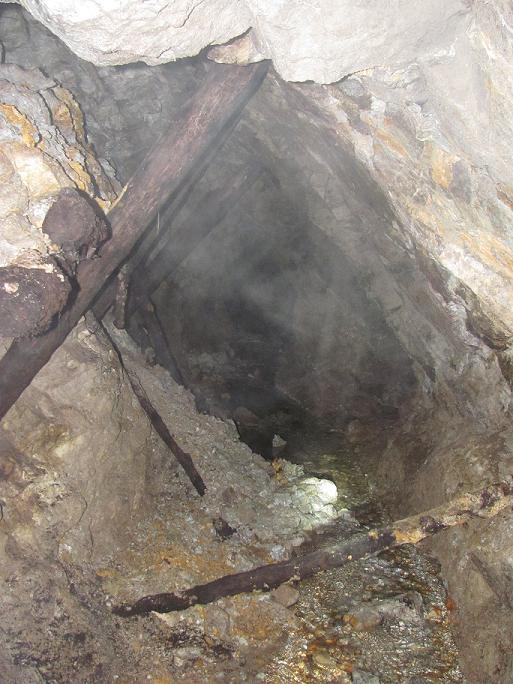
This part of the mine has kinda caved in. Cave-ins are what cause the hair on the back of your neck to stand up as soon as you enter a mine. The hilarious thing is that you are far more likely to die from falling down an abandoned shaft or breathing bad air than you are to die from a cave-in! Ahhhh, go ahead and laugh at yourselves for being so foolish, then let's move on.


Look at this! Another stope! Also there seems to be another tunnel heading off to our right! What mysteries await us down that tunnel? Nazi Gold? Inca Jewels? Or is it something dangerous like a rabid bear, evil Santa, or a Nissan Cube? Let's boldly go where no one has gone...for a while!


Turns out that there was nothing down that tunnel at all. Just some scary darkness. A little further down the tunnel was a hole that lead down into the bowels of nature. I didn't take any pictures of it because I was too busy trying to get away from it. Sometimes mines have unmapped holes. Let's go down the main tunnel some more. I have a feeling we are about to find something awesome. Like good Santa.


Nope! It was the original rails for the ore carts! Still in place! Usually the mines would pull up their tracks whenever they could because you could sell them for money. Mines were largely ventures that were operated with the intent to make money. That's an important thing to remember. But what about the people who used to work these tunnels? What other artifacts can we find that tell us about them?


Well, we know that they drank Schlitz Beer! This can may indicate that someone was in this mine at some point in the 60's or 70's. Unless the miners in the 1930's discovered some way to obtain beers of the future, which I doubt. Who knows though. Hey, maybe that's what this other mysterious panel of miner's musings is all about.


Looks like we have the letter "S" as well as what may or may not be a crude drawing of an ample buttocks. And to think that these poor miners were born too early to enjoy the song "I Like Big Butts". Don't cry now! We've got to finish off the mine!


Oh, here we are. That my friends, is a backfilled tunnel. Sometimes the miners would do this with their waste rock if they had decided that a particular part of the mine wasn't going to work out. You can't tell from the picture, but there is water squirting out from all over the place, so I'm guessing there is some water behind that playful little wall. Let's retreat to a safe distance and take a moment to learn more history.

The confidence mine was not a huge producer. In fact, it was not even a large producer. It was more of a small producer. Leaser mined a little ore in 1931, and in 1932 it produced a small lot of ore that assayed at $30 to $40 a ton in gold, 100 to 150 ounces of silver per ton, 30% lead and 7% copper. These numbers were measure in 1932 dollars, which would be more like $3000 to $3400 per ton in gold nowadays. These numbers are very impressive, but I don't know how much of the ore they were able to pull out of there. I guess it doesn't matter as in 1934 S.A. Parry, president of the Union Associated Group bought the farm and all mining at the Confidence Mine was ended. Now it's all flooded.

And so ends the saga of the Confidence Mine. Our shoes are wet, but our souls are enlightened with geological empowerment! Now, I'm going to go get a burrito. Good day.

Monday, August 1, 2011

Ghost Town Tuesday - Dividend, Utah

Ghost towns are frustrating.

The works of humans are amazingly short-lived. Say you woke up one day and somehow you were alive in the year 1880. I don't have the energy to think up why this has happened. Maybe you've had a stroke and just think you are in the year 1880, I don't know. Either way, what is the first thing you do? If Back to the Future III has taught us anything, it's that you first need to dump a large load of manure on the town bully to establish yourself as the hero.

After that, we don't really have a script for what to do next. It is my opinion that the first thing you should do is build some sort of store out of wooden planks (as is the style) and sell overpriced, watered-down whiskey to filthy people with bushy beards wearing those ill-fitting suspenders. Like this guy.


(I just needed a picture of an old prospector. I don't know why he is panning for little multicultural human torsos. Ignore that part). Expect to do this for a good 6 or 7 years until you get shot, drink some bad water and get a gut worm, or until the nearby mines run out of ore. After that, what you do is none of my concern. But what about your store?

Without maintenance, your average wood-plank structure will probably last a good 30 years before the weather or gravity or teenagers finally destroy it*. If it was built by some sort of legendary wood-plank builder company, it may even last up to 90 years. But that's about all you are going to get. After that, it will fall down and re-enter the food chain and that will be that. And therein lies the problem with ghost towns.

The ghost town of dividend has largely re-entered the food chain. In fact, it looks much like a field that has never been populated.


That, my friends, is the town of dividend. While it may not look like much now, it was once a place where things were much less....field-like.

The story of Dividend begins in the grand old year of 1916. Woodrow Wilson was president, cars still made that amusing "Ah-ooo-gah" sound, and deaths from digestive diseases were down while World War I related deaths were way up. But these things don't concern us. Our story centers on this guy....


That kindly-looking gentleman is EJ Raddatz, and it was his dream that gave rise to the town of Dividend. Mr. Raddatz was a prospector (despite the overall lack of beard and blood-alcohol level of 56%) and he had a hunch about a plot of previously unproductive land in the East Tintic Mining District in north-centralish Utah (here)...


Look at that! An old-timesy image of Utah! Taken straight out of an old government document written about the very subject we are covering! I feel it adds an air of professionalism to what is otherwise a pretty lightly investigated post. Go ahead and look at that map whenever you think things are getting too stupid. Anyway, that map was prepared in 1919, so let's update it a little bit....


There. Now we've brought it to the 2000's. That little square in the middle is the area we are looking at, by the way. Let's zoom in....


That last picture got all blurry. Maybe it will be better if you click on it. Anyway, that's an aerial photo of the townsite. You can still see the roadways! What's unusual is that you can't see them from ground level. Ahh, technology. Let's get back to Mr. Raddatz.

Mr. Raddatz knew there were minerals under his feet. We don't know how he knew that, but he knew that he was standing on a great spot for a mine. The year was 1907, and mining was a great way for anyone with a little capital to strike it rich (or lose everything trying). Mr Raddatz was no exception, so he created the Tintic Standard Mining Company and released a million shares of stock in an attempt to raise the funds he needed to find the good stuff deep within the earth. To help him with the actual digging, he hired this man....


That there is John Westerdahl, an experienced miner and first foreman of the Tintic Standard Mine. Mr Westerdahl and crew dug and dug and dug this shaft.....


(That shaft has since be reclaimed, so this may be the only time you ever get to see it. Bask in the glory!) For months they dug blindly into the hillside until the money started to dry up. The miners started to get paid in shares of stock instead of money, which wasn't great at the time as the mine had yet to produce anything of value. Most miners sold these shares or traded them for booze. Then one day they noticed a weird gas coming out of the shaft....


The government geologist inspected the site and determined that the gas was coming from some large sulfur-rich ore body! At last some good news! In 1916 the miners finally found the big pay day. At a depth of 1,200 below the very place that Mr. Raddatz was standing years before existed a massive lead-silver deposit that would prove to be one of the largest strikes in the Tintic District. It was named the Tintic Standard Mine.


(Look close, you can still see the words "Tintic Standard" written on the tanks). By 1918, a town had sprung up around the mine. At first it was just housing for the miners, but soon it also featured a school house, a store, barber shop, pool hall, a post office and hotel. A newspaper, The Standard, even showed up from 1924 to 1925. A population 350 men, women and probably some children called this land home, and anyone who had kept their stock certificates were rewarded with over one and a half million dollars in dividends from the mine by 1922. As was usual for such a town, the mine towered over everything....


The town was to the east of the mine and consisted of a few streets of nicely organized houses.


The mine complex consisted of the shaft (actually 3 shafts. Shafts are an important part of any mining venture), the assay house....


(You may be saying "Hey! How do you know that's the assay house? That could be any pile of rubble! I hate this blog so much!" Well, I know because the ground is littered with these little assay cups....


(And where do we find assay cups? Why, in the assay office. So that's how I'm guessing this was the assay house. So get off my back already.) Also included was a warming house, where the miners could warm up after being down in the mines....


(The warming house also made it difficult for miners to "borrow" pieces of rich ore for themselves. You see, if rich ore was struck and you could sneak it out of the mine without that jerk of a supervisor seeing you, then you could trade that ore in for all sorts of whiskey. This practice was known as high-grading, and mine owners hated people who did it. Almost as much as cave-ins and the environment).

Also included was the company store....


One of these things....


A railroad to get the ore from point A to point somewhere else....


And a variety of things that fall into the "misc" category....


Look! Here's an old mine elevator! This little bugger made countless trips up and down and back up again before being forgotten on a heap of waste rock. There's a lesson here kids. No matter how hard you work, everyone ends up sitting on a pile of waste in the end.


Ore from the mine assayed as high as 80 ounces of silver to the ton, and 22 percent copper. These are good numbers for a mine. It's like having a blood pressure around 110 over 70, or getting 40 miles to the gallon. The ore was chased down to the 1,600 foot level, with galena, tetrahedrite, pyrite and sphalerite forming the most valuable ore. This little guy showed up from time to time too....


That is a mineral named argentojarosite, and if you love silver, then get this mineral drunk and take it home to bed. It's basically silver with some yellow mixed in. The Tintic Standard Mine was the first place this mineral was ever discovered, and as such it has become the "Type Locality" for it. It's an honor to be considered a "type locality" for a mineral. It's like being the kid who finally breaks the pinata, or getting a seat on the bus that isn't covered in urine stains. Pretty great.

And so, the mine pumped kept pumping out minerals. For a while it was the leading silver producing mine in the United States, and gained a relatively high degree of fame for being so. In order to process this ore, a large, state of the art mill was built on the western slope of the mountains to the east of the mine, and was named (not surprisingly) the Tintic Standard Reduction Mill.


That mill lasted from 1921 to 1925 before it shut down due to the whole thing going from innovative to obsolete. Kids love painting things on other things, so now the mill looks like this...


At some point during the operation of the mill someone managed to steal a 50-ton ore car of high-grade ore (in an epic example of "high grading" as described above). The ore car was found 6 months later in Mexico, but was as empty as chubby kid's self-esteem. I didn't steal it, but I certainly can see why someone did.

In 1920, the town decided it needed a name. It had been going by the name "Standard" (if you don't know where they came up with that name then you need to read things more closely). The problem with that is that there is a town named "Standardville" in Carbon County, and it was messing with the postal service. So a contest was held to come up with a new name, and the name "Dividend" was selected. Again, you should be able to figure out where this came from too.

I hate to have to remind you, but we are dealing with a ghost town. This means that at some point things have to go down-hilll for the town. Prosperous towns don't just suddenly wrap up shop and go on their way. Only loser towns. And sadly, Dividend's term as a place that exists was nearly up. In 1949, the mine ran out of paying ore and the last shipment was made during that year. Don't feel bad though! During the period it was worked, the mine produced 2,327,148 tons of ore valued at approximately $80,000,000. A tasty $19,000,000 of this total was paid out to lucky mine shareholders who didn't use their shares as toilet paper during the rough times.

With no mine, there was no need for a mining town. And so, as we've seen before several times, the town got flushed down the big ol' history toilet.


The majority of the buildings were removed in the 50's cus if they don't exist you don't have to pay taxes on them. Any houses that weren't removed suffered a teenager-based end (lit on fire). So that leaves us with this....


That is to say, not a whole lot. A few concrete foundations, a few stone walls and probably a whole bunch of ghosts. The mine is really the only item of interest in the area (unless you really like concrete foundations and a few stone walls). It is because of this that I made that rant at the start of this post. Ghost towns never seem to last.

So we leave the once busy town of Dividend. Perhaps one day new mines will be discovered in the area and the town will be re-built and the mines will roar back to life. It's not very likely though. I'm going to go trade my shares in for some whiskey.


*If you have really chased this Astrix all the way down here from that first paragraph, I just wanted to make sure that you all know that I have no idea how long wooden structures will last if they aren't maintained. I hope this was reward enough to justify worrying about it.