Let's go to the main event. Or should I say, the MINE event! No, no I shouldn't. Because that is a joke that only the old and dangerously shy would make. I think I've made this point before, but it's worth restating. Jokes about geology are a very slippery slope (landslides!). One second you are the king of the party, I mean, you are killing it. Where you go, the party follows. You're feeling confident, too confident. So you let loose with a geology joke. Perhaps it's about how quartz forms in inappropriate shapes, or perhaps you go the route of how stupid metamorphic rocks are. Either way, get ready to go to bed alone. Forever.
(See how I slipped a landslide joke in there? It wasn't funny, but it did prove the point I was making. So lonely).
Well, let's move on for reals. Here we are.....

Why are we here? Have I really dragged us away from our important real-life doings to look at what is likely a structure that is no stranger to meth? On the surface it may look like I'm going to attempt to write an entire blog post about a pile of tetanus. But let us not forget the famous saying, "Don't ye judge a shed by the....structural integrity....of it". Some of that may be off. My Shakespeare is a little rusty. Anyway, in all actuality that pile of debris is hiding the Tar Baby Mine.
As we've learned before, the first step in going into a mine is to find out where the mine is. This can be a problem, as mines tend to blend in with their surroundings very well.

Well, sometimes. Mines kinda do what they want. Anyway, I only bring this point up because I actually had no idea where this mine was. I don't know much about nature, and I subscribe to the school of thought that predicts that if you go wandering out into the bushes looking for something, then investigators are likely going to find your remains in a pile of moose scat, or perhaps the scat of any number of horrible things that are just waiting for us to go outside. Scat is a funny word.
Anyway, we need clue. Something that will let us know that we are close to a mine. We know that the mine is located somewhere in Big Cottonwood Canyon. This area....

Um. Pretend that map says "Tar Baby Mine" instead of "Confidence Mine". They are pretty close and I'm too lazy to go switching all that up. Anyway, what clues do abandoned mines leave behind you ask? Well, they can be subtle, but the clues are there. For example, take a look at this!

Look at those unusual sticks laying there on the ground. They seem to be trackular in nature. Almost too trackular to be ignored. If you find tracks while wandering aimlessly out in the woods, then chances are you are either near a mine or you are actually standing on a particularly well vegetated portion of a mass transit, system and will likely soon be in the newspaper. Luckily, for us, I know that we are actually very close to a mine. And by me I mean the guy who showed me where this mine was.
And so, in we go.

Wave goodbye to the outside world with its
promises of fresh air and loved ones!

Let us enter the world of unnecessary
risk! Speaking of playing unnecessary risk, some of you may notice a few crazy
orbs near either side of the metal tracks near the center of the photo. Now,
some folks (democrats mostly) believe these orbs are ghosts, but in orb form.
I’m not here to tell you what to think concerning these spherical potential visitors
from the other side. This post is about a ghost mine, not ghosts in the mine.
That’s a whole different subject that requires an audience that is much more
amenable to alcohol and frizzy hair.
Let’s wander in a little deeper. The Tar Baby Mine was
incorporated way back in the glorious year of 1911, and was worked until the
late 1930’s. Ah, 1911. I remember it like it was yesterday. I don’t have a joke
to end this statement. Ah well. Look!

Here are some more ancient words from the
past! RWR 1938 and 1936. After extensive research (a google search) I have been
unable to determine what exactly RMR refers to. Sometimes the past is
mysterious.
Anyway, let’s see what lies ahead! The Tar Baby Mining Company initially drove two adits
(remember folks! That’s a fancy word for horizontal tunnel!) into the
mountainside. This particular adventure was completed within the lower tunnel.
Sadly, the upper tunnel has long since passed from this world and has moved into the world of collapsed things. That world sucks. Anyway, the nearby
Cardiff Mine was making more money than two prize winning racehorses duct-taped
to six or seven software engineers all while being ridden by the world’s most
frugal pimp. Typically when one mine is pulling in the dough, people will get
the idea that if they stick enough holes into the mountainside nearby that mine, then they can
earn enough money to buy a few racehorse-pimps of their own. This was the
thought process of the Tar Baby Mining Company. Lookie here! A stope!

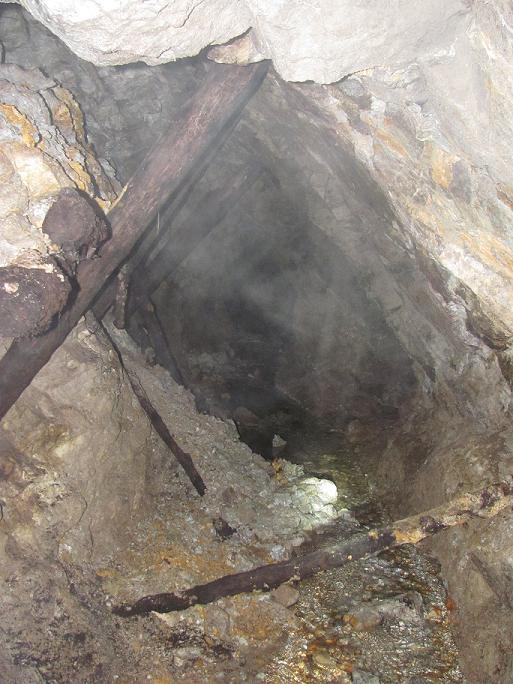
Do you remember what exactly a stope is? It is a big cavern
that is created when the miners dug all that sweet, sweet goodness out of the
ground. They usually are propped up using all sorts of various wooden devices,
as seen here. Also sometimes they have moldy old ladders in them, as also seen
here. You know what happens to wooden devices when you shove them in water for
a long time? All sorts of horrible things start to grow on them. See?

It’s not unusual to come across these horrible furry
little devils while mine exploring. I’ve always tried to avoid them, but sooner
or later they get you. Nothing happens, it’s just unnerving. Like when a
lightbulb burns out while you’re peeing, or driving near old
people. Uh oh, looks like we've got problem.

In hopes of drawing larger viewership from the powerful "I want to interact with this blog" crowd, I'm going to let YOU the reader chose which way we go next. Go ahead! It's easy! Just select the way!
Nah, we're going left first. Go make your own mining blog if you want to make the decisions! All bow before me in this electronic world of nerdy pastimes! The Tar Baby Mine was geologically very similar to the afore-mentioned Cardiff mine, so it makes sense that the miners and owners (mostly the owners) were very optimistic that their mine would be an equally shining monument to the world of lung disease. They drifted in and encountered this little fella....

That may not look like much, but you've got yourself an ore vein there. That's what it's all about. A two inch wide vein of silver- and gold-rich pyrite and galena. But there isn't enough there to do anything with (that's what she said). So let's follow it down a ways and see if the vein ever opened up into something worth risking your life over....

This material averaged over 120 oz of silver per ton, and also had a smattering of gold in there too. I don't know how much. I could make something up if you want. This material contained 7 gold. That seems pretty good. Ah, now here's something...

The vein continues! And now it comes with numbers! 3117. I'm not sure what this means. Miners didn't leave a whole lot of ways to decipher their cryptic and often mildly offensive markings! But rest assured, at one point that meant something very important to somebody. At this point the vein takes a sharp turn to the downward, which would be a problem if we weren't dealing with a group of people who had nothing else to do but dig downwards. And so they did...

That there is a prime example of an inclined shaft (that's what, ah, nevermind). When veins galloped off into the hillside at an angle, the miners would chase it, like a sweaty, ill-tempered hobo chasing a pigeon. What? Anyway, it can be hard to lift ore up things, so it would be nice to have a little engine at the top that would do it for us. Ask and you shall receive!

That there is a hand-operated windlass (elevator thingy). You turn that wheel, and your ore cart comes trudging up towards you. Or at least that was the idea 100 years ago. Now I'm guess that if you turn that wheel you will probably end up with a rusted bit of metal in your hand. Sadly, this concludes our trip down this tunnel as it got real collapsy looking from there on out. But the Tar Baby Company chased this vein for thousands of feet down this shaft, and only found a few hundred tons of high-grade ore. That sounds good to me, but I guess that's not considered a good return. This may be a good time (and if it's not I'm doing it anyway) to investigate what we are seeing here with regards to geology. I mean, that's what we are all here for, right? Give us geology or give us death, and all that. Well, long story short, it's very complex. And what do we do when things are complex? We make gross oversimplifications in the medium of stick figure drawing. Let's do that now!
The first important step in Utah's geologic history is a long one. A step largely covered in water. You see, for the past zillion years, Utah has been a quiet, unassuming part of the ocean floor. As opposed to now, where it is a quiet, unassuming part of the desert floor. Anyway, the point to take away here is that for most of it's history, the western U.S. has been very soggy.

The next important step in the formation of the Wasatch Front (that's what us Utahn's call the Wasatch Mountain Range) is the drying up of all that water. This actually happened several times, but I'm not in the mood to draw several pictures. So this one is going to have to do.

There we are. Those lines are supposed to represent several different layers of rock that were deposited by the sea. Oceanic environments typically deposit rocks such as limestone and dolomite, both of which are readily susceptible to having ore deposits shoved within them....
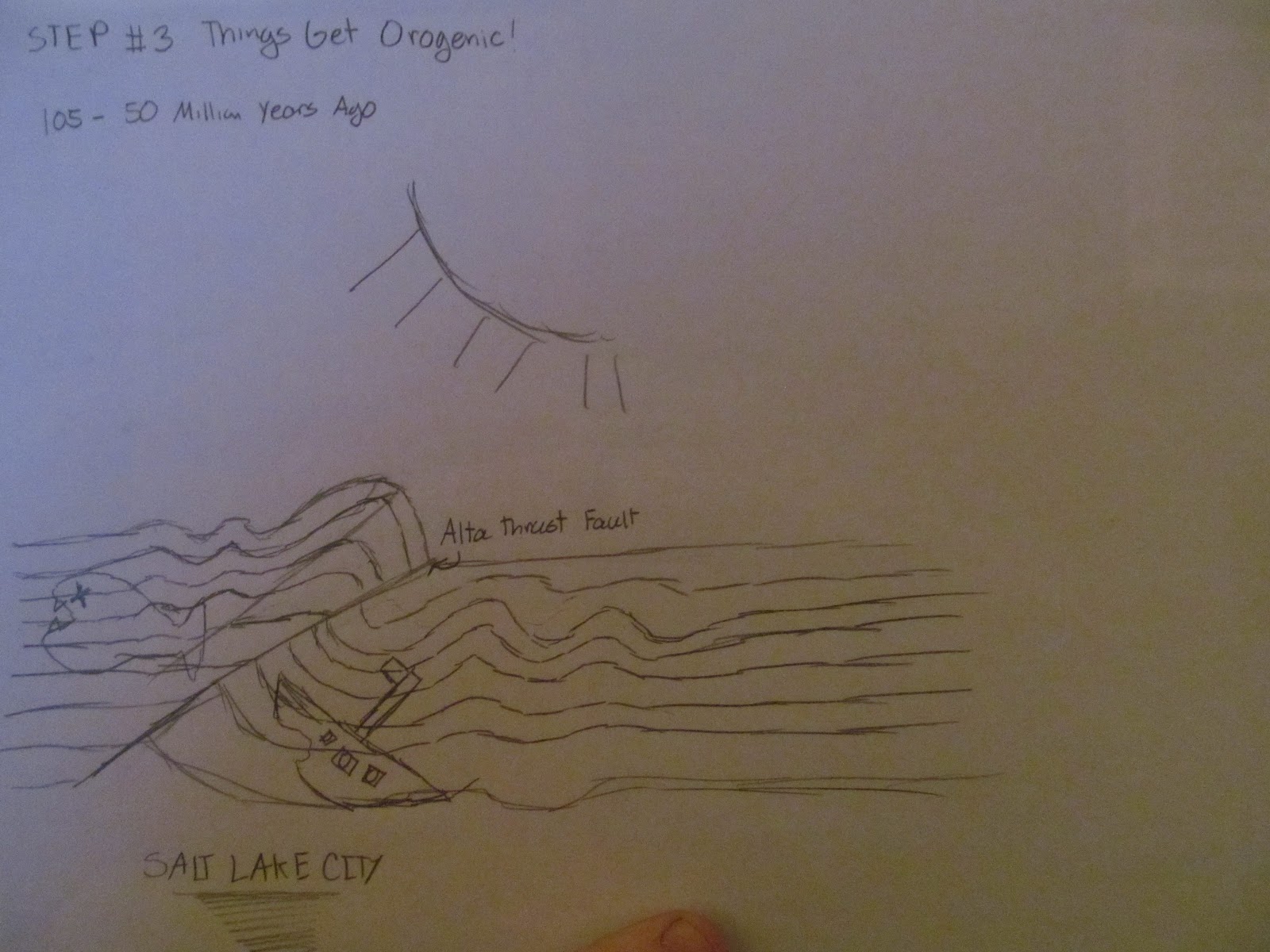
Here's where things get odd. About 105 million years ago, Utah got squished by the early version of the San Andreas Fault. Yes, before it was destroying the L.A. Lakers, that fault was busy shoving much of Utah over much of Colorado. I would love to get into the details here, but we really do need to get moving. So you will just have to trust me about this. What's important to take away from this is that this compression formed several very large thrust faults. Faults are large cracks that form in the crust that allow various parts of your community to move past parts of other people's communities. Also they destroy everything. Let's move onto step.

Also it's important to observe the formation of the Alta Thrust Fault, a relatively large crack in the surface of the earth that is important in this next step. The Alta Thrust Fault was created as a result of older rock being squished on top of younger rock! Imagine that this whole situation is a sandwich that just got caught in a trash compactor. As a result of the compaction, the mustard got squished on top of the ham, even though you put the ham onto the sandwich first. Then, about 40 million years ago, step 4 began. A relatively large body of hot, mineral-rich magma got shoved into the sandwich. In doing so, the magma body forced mineral-rich fluids into the limestone. This was particularly true along previously created fault lines, such as the Alta Thrust Fault. Is this important? Oh my yes.

The compression that was so effectively created the Alta Thrust Fault soon gave way to extensional forces, which created the Wasatch Mountains as we know them today. The valley floor dropped to the west, while the Wasatch Mountains rose to the east. This allowed our tobacco spitting, prostitute visiting fore-fathers to discover the wealth that the volcanic intrusions left behind! Sadly, the Tar Baby Mine is located pretty far away from one of those magmatic intrusions, and as such it received very little ore-body building material. That little bit of information would have saved a lot of people a lot of time in the 1920's.
And so, there we are. A hugely complex geological event summarized into five poorly illustrated steps. Let's move along.
Let's get out of this tunnel of disappointment. Maybe the other tunnel will reward us with geological riches!


It's like being birthed, but with less birth-sauce everywhere. Now here's something you won't see (hopefully?) in any birth canal....

More miner writings. I am starting to suspect that these are the initials of some long-dead miner. But it could just as likely be literally anything else. So, again, not helping you out a whole lot with "facts". Let's keep going.....

Ah, a dead end. Or is it?????

This picture doesn't clear anything up, does it? Well, what you are seeing is a raise (upward shaft!). Or more correctly, you are seeing some boards that cover a raise...

This shaft was completed in 1913, and was largely used to ventilate the mine by bringing in air from the surface some 800 feet upwards. As a fun fact, it also connected with several other of the mines in the area! Everyone loves fun facts.
Well, there you have it. A really creepy looking part that I don't dare go down and a shaft that goes straight up. I'm calling it a day. Let's go back outside and see if we can find something cool laying around. Ah ha! We didn't have to wait long!

Ah yes, the miner's most valuable piece of equipment. This mine was worked largely after the period in which prostitutes were plentiful, but I'm guessing one or two still made it up there. And so their legacy lives on. Largely in the form of illegitimate children.
Oh, a few last thing to touch on before we start re-reading this post again (because it was so good). There were reports of additional rich mineralized veins located by folks who leased the mine (generally mining companies lease the rights to pull out whatever you want from their mine once they have gotten their fill) located at deepest portions of the mine, but excessive water made it too dangerous to work down there. So the 1940's hit and everyone went home or to war. And so ended the Tar Baby Mine.
The end (officially).