Thursday, July 14, 2011

Ghost Town Whatever - Iosepa, Utah!

Western Utah is a neat place to visit. As we have covered (repeatedly) on this blog, you can find mines, cattle, rusted objects of nearly any size, crazies with guns, barbwire (the fence-object, not the movie), the military, the potential to become encrusted with salt, and any other number of things that drive people mad with visit-lust. Western Utah, however, is NOT a neat place to live. You can find mines, cattle, rusted objects of any size, barbwire, the military, the potential to become encrusted with salt, and any other number of things that drive people mad with I-don't-want-to-live-here-lust.

However, once in every great while, someone figures that they will give it a go and they pack up all their belongings and head out for the great and probably haunted western portion of the state. This well-written introduction gives us the backdrop for our next little ghost town....


You may notice that sign has a rather "island" theme, what with the aloha and all. And there's a reason for that, but I'll touch on that later. First lets get our bearings. If you find yourself with a mean case of Iosepa-madness and want to take a look for yourself, you can find the place here....
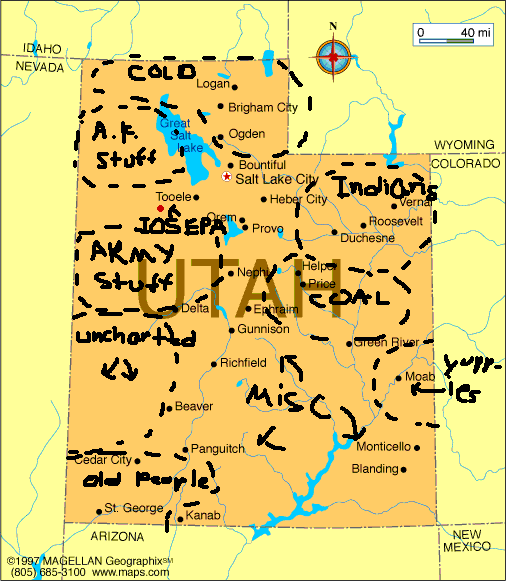


Or, just drive around and look for this sign...


It's kinda near Mercur and Ophir and stuff. The nearest city with people is Tooele. Well, technically it's Dugway, but don't go there....


The story of Iosepa begins way back in the fruitful year of 1889. Well, technically it begins earlier. Geologically it begins even earlier than that, but I'm not going to talk about that. In the 1880, Mormon missionaries had been hanging out in Hawaii doing their thing, and as a result, they converted a number of Hawaii-folk. These converts decided to visit Salt Lake City for themselves and check out what all the fuss was about, and upon visiting they decided that they would like to stay and help build the temple and then visit the temple and do all the other things that mormons like to do. At first there were 50 or so visitors, then 75, and so on and so forth.

But people are fickle things. Sometimes we don't all get along because we are jerks. The Hawaiian visitors soon found that most of the folks living in the city were strange and had very little to no Hawaiian culture in them, so they decided that they would like to create their own little city. Now, Utah has very little useful land, and by the 1890's most of that land was already spoken for. So the Hawaiians got a slightly less than ideal plot....


In 1889, a whopping 1,280 acres of that stuff was purchased at a cost of $40,000, and with that the mighty metropolis of Iosepa shuttered with its first mighty breath on the night of August 28th of that year!


It didn't take long for the good Hawaiian folks to realize that this....


Is a different experience than this...


And there's way less this...


And much much more of this....


But they were a determined bunch, and that spring the townsite was surveyed so every adult male and widow got to draw lots. They named the town "Iosepa" which is "Joseph" in Hawaiian. This was a shout out to both the Prophet Joseph F. Smith, who was a very successful missionary in Hawaii, as well as to the other Prophet Joseph Smith, who established the church. That's an example of multitasking I suppose. In 1890, the site was dedicated by the Prophet Wilford Woodruff, and with that the flag went down and the colony was ready to take off. Only it didn't really. Here's some of the chaps now!


The town was soon exploding with well-built houses, a church (presumably of the Mormon faith), a school house and roads to get to all these places. Concrete pipes carried every last drop of water from the hills down to the town, and fire-hydrants were installed. This was a good idea, as fires prefer damp-free environments such as western Utah. Probably the most impressive project was the lake they dug in the middle of the valley....


I've never dug a lake, but I'm assuming it is a very difficult thing to do. They stocked the lake (named Kanaka Lake) with trout and carp and other fish for feasting on, and even tinkered around with growing various sea-weeds. Neat!

In an attempt to make the valley somewhat less horrifying, cottonwood and poplar trees were planted down the center of each of the roadways, and yellow roses were planted in most of the yards. Corn, wheat, barley, beets and other delicious foods were grown in the fields, and cattle and pigs were free to walk about and grow fat for the slaughter! In addition, 300 fruit trees, 300 walnut trees, as well as 100 ornamental plant-like objects were installed. The residents of the town even celebrated their version of pioneer day on August 28th instead of July 24th like the other folks. For a while, things seemed to be actually working. In one year the residents made a cool $20,000 in profit from their cattle and wheat and such. Most years weren't that kind though.

And so things went. As if hard work and exposure wasn't enough, a friendly little visitor named leprosy came to town, and three residents soon found themselves swimming with the disease. A "pest house" was built at the edge of town and the three residents were isolated from the rest. They could raise a flag when they needed something. Here are the three lepers nowadays...

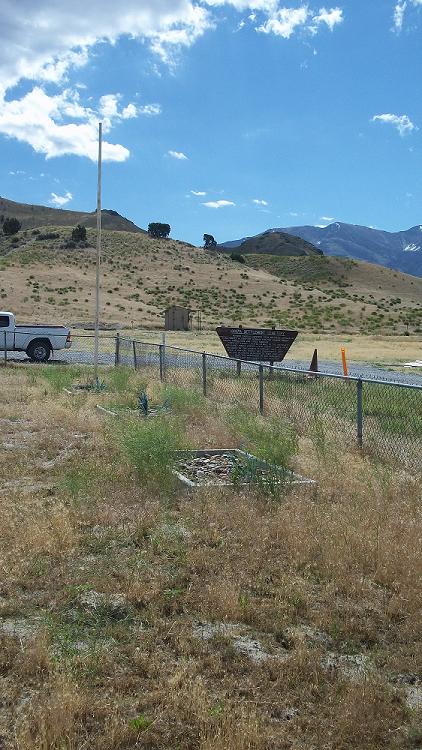


The flagpole at the back of the picture was built in their memory. If you see a flag up there, then that means they've come back as zombies and you should stay away. Anyway, this was the only leper colony to ever exist in Utah. Unless you know about one that I don't I guess. If you do, go write your own blog and leave me alone.

By 1901 the population stood at 80 brave souls, and it would reach a maximum of 228 by 1915. The city won the state prize for being the most progressive (whatever that means) and best kept city in the state in 1911, which is pretty good for a town located in a placed called Skull Valley.

The main problem facing the town was the fact that everyone kept dying. The climate and difficult work kept killing people off faster than they were being born and moving in. As a result, the cemetery soon became a very big place....


Unlike most of the towns that we have looked at so far, the graveyard isn't filled with people with names like "Ol Prospecting Alcoholic Jim" or "Shotgun Prostitute Sally". It's fill with names like this....


I'm not sure that Besse Peters was Hawaiian. Doesn't seem like it fits with the others. There actually were a few white folk living in town, so maybe she was one of them. I'd ask her but she's pretty dead.


Connie Hoopiianina was actually not the last burial. That belonged to this lady....


The Hoopiianina family was one of the few who stayed in the state. We'll cover that later. This next grave belonged to the local judge. Now he's the one behind bars.


Ironic, isn't it? Nope, it isn't. The official historical marker put up by the the state of Utah is near the cemetery. The bust on top is that of a Hawaiian warrior, which is pretty neat.


Having an accelerated death rate is a bad promotional tool for a town. In 1916 the Mormon Church announced plans to construct a temple in Hawaii. This rendered the town of Iosepa obsolete, and by 1917 the remaining townfolk sold their property to the Church and most moved back to Hawaii. And so ended the little hamlet of Iosepa.

Not a lot is left out there. Obviously there is the graveyard, as we've seen. The townsite was later sold to the Deseret Livestock Company, and cattle became the new residents of Iosepa. There are still four houses standing and occupied by ranchers!


I didn't dare go very close because sometimes people in western Utah get a little shooty if you wander onto their land. Something to think about whenever you go out there. Other than those remaining houses, the land offers very few clues that it was once occupied....


Miles and miles of sweet sweet nothingness. Something in this bush was making a really loud, terrifying noise....


Then when I was walking back when I was attacked by the worst creature Utah has to offer...


That is one of the most terrifying thing I have ever found on my shoe. At nearly 10 feet long and weighing in at approximately 4,500 pounds, this cricket-like car was reason enough for me to leave the place. Also I technically should have been at work.

And so my visit ends. There is now a pavilion built next to the graveyard in which a large luau is held every Memorial day weekend. Seems fitting. Also they cook pigs and emu in these crazy pits...


So, if you've got a hankerin' for some sweet sweet bird meat, and aren't scared of T-Rexickets, then I vote you go. I can't make you, and I don't care what you do, but think about it.

Wednesday, June 29, 2011

Behold!

This post isn't about rocks. It isn't about ghost towns, mines, homemade dilbert cartoons, or any of the other stuff I usually pass off as educational material. No, this post is about the fact that our little club of virtual geologists has expanded to 32 people! No longer could you fit us all in a sensibly-sized sedan! In fact, there are restaurants that would have a hard time accommodating us all! So go ahead and give yourself a hearty handshake (don't let other people see you) and drink deeply of the milkshake of self-satisfaction! And as added bonus, I figure I might as well let you all have a sneak-peak into the things I have planned for this blog....More of the same! Everyone hates change!

Thursday, June 23, 2011

Ghost Town Thursday - Silver Reef, Utah (Part III)

Alright, I've given you all a couple of months to absorb and appreciate the monumental amount of well-documented history I presented in the last couple of posts. Hopefully you have all taken advantage of the opportunity to reflect on what Silver Reef means to you. Sadly, it probably doesn't mean a whole lot, although I suppose it would be equally sad if it meant too much.

At the end of Part II (which you can read below again if you want, but I warn you it hasn't changed), things were really getting underway for the hamlet of Silver Reef. And if there's one lesson that history has repeatedly taught us, it is that wherever you find people you are going to also find corpses.

People like to hang out with people who share their interests. This shouldn't come as a surprise to anyone. If you are a chef, then chances are that you will spend your time with similarly culinary-oriented folks. If you are a hair-cutter, then you will probably enjoy swapping stories about hair (and the cutting thereof) with other hair-cutters. The only people who don't follow this trend are the odd folks who spend their time dreaming about forming militias and mailing explosives. Those people tend to stick to themselves, which isn't necessarily a bad thing. Corpses also like to hang out with corpses of similar interests. In Silver Reef, the corpses have been sorted according to religious beliefs. There's the Catholic Cemetery...


Unfortunately time has taken its toll on the headstones of the land, and most of them have (like their owners) turned to dust. The area is now filled with simple wooden plaques that say "Unknown".

Say you were a Protestant and you found yourself without a pulse in Silver Reef. Then they would shuttle you off to the Protestant graveyard.


This graveyard too has very few original gravestones remaining, and thus is also filled with unknown bodies. But it still has a few survivors....


The first thing you will notice after walking around an old cemetery is that gravestones used to be way sadder. Nowadays people write stuff like "Well, I died" on their graves. The older gravestones have sad little poems and messages to their kids and family about how much everyone misses everyone else. I don't know why this has changed, as death is still somewhat inconvenient to the survivors. Maybe we are just better at accepting our fates nowadays.

Silver Reef had a booming Chinese population who operated laundries, opium dens and such. It was rare that Chinese folk were allowed to work the mines (cus racism), so they did the other tasks that presented themselves although they were usually poorly paid for doing them. The Chinese had their own cemetery in Silver Reef, but at a later date a Chinese guy who lived in Silver Reef for a while made a fortune in San Francisco and paid to have all the Chinese corpses dug up and sent back to China. So now there isn't a Chinese cemetery.

Anyway, this is no time to fixate on the dead. There were still plenty of living folks in Silver Reef!
These folks worked the mines, crushed rocks, served beer, spit, cussed, and did all the things we've come to know and love about old mining towns. By 1888, most of the mines had reached a depth where groundwater started to be a problem. You see, humans have a hard time working in water that is deeper than they are tall. Pumping water out of a mine is an expensive proposition, and the deeper you go, the more expensive it gets. All the mines on the southern portions of the district struck rich deposits of water at about 300 feet. Also the value of silver dropped like a rock and it soon became hard to justify dropping yourself down into a soaked, dank hole in the ground for the stuff. Formal operations closed up shop, and for the next few decades the mines were leased to "chloriders" or independent miners who didn't answer to anyone. These folks, as entrepreneurial as they were, were not enough to justify the continued existence of a town, and so, Silver Reef was abandoned.


Most of the houses were sold off for the bricks, lumber and dreams they contained. One lucky gentleman found $20,000 worth of gold coins within the walls of an abandoned saloon, and soon everyone with a deed and a sledgehammer was bashing into their houses looking for more wall-bound treasure. What wasn't bashed down to the ground was burnt to the ground in 1908.

Things were pretty quiet after that. For 20 years the place just sat as a burnt, smashed wreck. Then, in 1929, the American Smelting and Refining Company decided to poke around and make sure nothing was missed the first time around. In order to connect up with several of the other mines, they sunk a huge shaft up on top of White Reef....


This impressive hole in the ground reaches for a good 540 feet below the surface. If you fell down it, you would have a few seconds to decide which graveyard to be buried in before you became all squished at the bottom. Anyway, at this depth, the shaft connected with all the other mines in the area. They poked around and found that the area still contains a bunch of silver, but nothing seems to have come of it, and the good folks of American Smelting and Refining Company took off.

And so, the district was again left to the ghosts and squirrels and whatever else lives out there. But it turns out that silver isn't the only treat the district had to offer. Uranium abounds in the district, and the miners of old probably enjoyed some extensive exposure to its DNA altering rays. I'm not saying that there are mutants living in the mines nowadays, but I can't rule it out. The Uranium Boom was underway in the years after WWII, and people couldn't wait to get down into the dirt and get some low level radiation poisoning. The Leeds Sandstone was filled with various uranium-bearing rocks, and in 1950 the first shipment of ore averaging 8.68 tons with 0.56% uranium was mined from the East Reef....


The new mining in the area gave rise to this mysterious mine! I don't know the name of it though. Let's call it "ol' holey".


Also, the Duffin Mine was re-opened. There's still some old mining stuff sitting around it, which is pretty slick. I think it was an old compressor, but I'm not sure. It was full of oil if that helps you imagine it.


As long as people were going to be nosing around deep underground, they figured they might as well investigate the potential for going back in for more silver as well. A few folks investigated the Cobb Mine (as mentioned in Part II) and discovered that silver still abounds in the sandstoney catacombs, but again nothing really ever came of it. Silver is a fickle mistress.

Anyway, in order to get the district back up and running for the uranium boom, a brand new ore bin was built right in the center of town.


But as any mining outfit worth its salt will tell you, a fancy new ore bin isn't enough. You also need a company headquarters. And so, the Western Gold and Uranium Company set up shop in the old Wells Fargo Building...


Contrary to popular belief, silver ore isn't all that impressive. It usually shows up at brown to black crusts, which is pretty disappointing considering the wide array of colors available to minerals nowadays. Uranium minerals, on the other hand, are usually pretty impressive. Take Carnotite for example...


Behold the slightly-yellow beauty! That little fellow was one of the ores that people were looking for deep underground. It is more radioactive than 30 mutant space cats. Take a look at the pieces that go together to form it!

CARNOTITE - K2(UO2)2(VO4)2*3H2O

See that little UO2 guy? That is Uranium Oxide, and for good or ill it gave us bombs of unusual kabooie-ness. The Carnotite deposits were put in place much like the silver and copper, namely, they formed around the plants that deposited with the sandstone. Carnotite seems to have an unusual preference towards forming around the sides of tree stumps. Anyway, there was a big pile of waste rock located near Old Holey, and I would imagine it will be reclaimed soon. Nothing brings down land values like having a big radioactive pit in your backyard.

If silver and uranium weren't your things, then you could always go into business mining this stuff...


That greenish-goo looking mineral is Volborthite, and unlike it Carnotite it doesn't have a lick of radioactivity in it. Well, unless it does. Minerals like to do crazy things sometimes. Anyway, Volborthite has a healthy dose of vanadium in it, which is used to make steel extra hard. Extra hard steel was all the rage in the 1950's.

Sadly, once again Silver Reef was to feel the bitter sting of being abandoned. Carnotite and Volborthite are good and all, but they aren't the sorts of things that really entice people to stick around. As a summary, the district shipped nearly $8,000,000 worth of silver (which is nearly $22,000,000 worth in today's money!), with the biggest producers being the Barbee and Walker, Leeds, Manhattan, Tecumseh, Savage, Buckeye, Maggie and California mines. I don't know the monetary value of the uranium that came out of the area, but I'm betting it was more money than I'll ever see. Recently the area has become repopulated, and several rather stately houses have been built only feet from the crumbling ruins of other old houses.

If you go to Silver Reef nowadays, the main attraction is the museum, which has followed in the footsteps of Wells Fargo and the Western Gold and Uranium Company by setting up shop in the old Wells Fargo Building.


The museum is free (although donations are appreciated), and has a neat collection of Silver Reef memorabilia, such as ore carts...


As well as assay cups...


Just to name a few of the items that are there for your visual enjoyment. I vote you go there. The same organization that operates the museum also is working towards possibly recreating a portion of the town. Which would be neat.

And so we leave Silver Reef (just like everyone else has done several times). Mining is dangerous work, and even moreso back in the day before anyone really was too concerned with safety. It was an unusual breed of human who was willing to jump down there every day for a living. It was hard work, but it was honest work (I would imagine. I wasn't there) and the old miners prided themselves on being honest men, and you know what they say about honest men...


THE END

But also, here are some other pictures of old mines in the district. They may have had names, but I don't know them. It's WAY fun to make up names for the mines yourself! Go ahead, give it a try! Remember we've already used Old Holey.